In the evolving landscape of the global food industry, the demand for clean-label ingredients has reached an unprecedented peak. Among these, organic chicken stock powder stands out as a critical component for manufacturers seeking to balance gourmet flavor profiles with strict organic certification standards. By condensing the rich, savory essence of organic poultry into a versatile powder, producers can maintain consistency across large-scale batches while appealing to health-conscious consumers.
The shift toward organic alternatives is not merely a trend but a systemic change in consumer behavior, driven by a desire to eliminate synthetic pesticides and growth hormones from the food chain. Utilizing a high-quality organic chicken stock powder allows food processors to reduce the complexity of their supply chains, replacing labor-intensive simmering processes with a standardized, nutrient-dense ingredient that ensures a stable taste profile.
Understanding the technical nuances of organic stock production—from the sourcing of non-GMO poultry to the precision of spray-drying techniques—is essential for any brand operating in the premium food additive sector. As global regulatory frameworks like the USDA Organic and EU Organic standards become more stringent, the role of specialized food additives in maintaining transparency and quality becomes paramount for market competitiveness.
Global Market Relevance of Organic Chicken Stock Powder
The global appetite for organic seasonings has surged as the "Farm-to-Fork" movement gains traction across North America, Europe, and the Asia-Pacific region. According to recent market analysis, the organic food sector continues to grow at a CAGR that outpaces conventional food additives, with a specific spike in demand for convenient, organic-certified savory bases. organic chicken stock powder serves as a cornerstone for this growth, bridging the gap between homemade quality and industrial efficiency.
However, the industry faces a significant challenge: maintaining the "organic" integrity throughout the dehydration and powdering process. Many manufacturers struggle to find a balance between shelf-stability and the absence of synthetic anti-caking agents. This gap in the market provides a massive opportunity for producers who can master the art of clean-label granulation without compromising the rich, umami depth that chefs and consumers expect from authentic chicken stock.
Defining Organic Chicken Stock Powder in Modern Food Science
At its core, organic chicken stock powder is a dehydrated concentrate derived from organic chicken bones, meat, and aromatic vegetables, processed under strict organic certification protocols. Unlike conventional bouillon, it excludes MSG, artificial colors, and chemically derived flavor enhancers, relying instead on the natural synergy of proteins and amino acids to create a savory experience.
In the context of modern food science, this product represents a convergence of traditional culinary arts and advanced thermodynamics. The transition from a liquid stock to a stable powder requires precise temperature control to avoid the Maillard reaction from over-browning the product, which would alter the delicate flavor profile and color of the final organic seasoning.
Beyond the kitchen, this additive addresses a critical humanitarian and industrial need: the delivery of nutrient-dense, shelf-stable protein flavors to regions with limited cold-chain infrastructure. By removing water weight, the powder significantly reduces transportation costs and carbon footprints, making high-quality nutrition more accessible globally.
Core Components and Quality Determinants
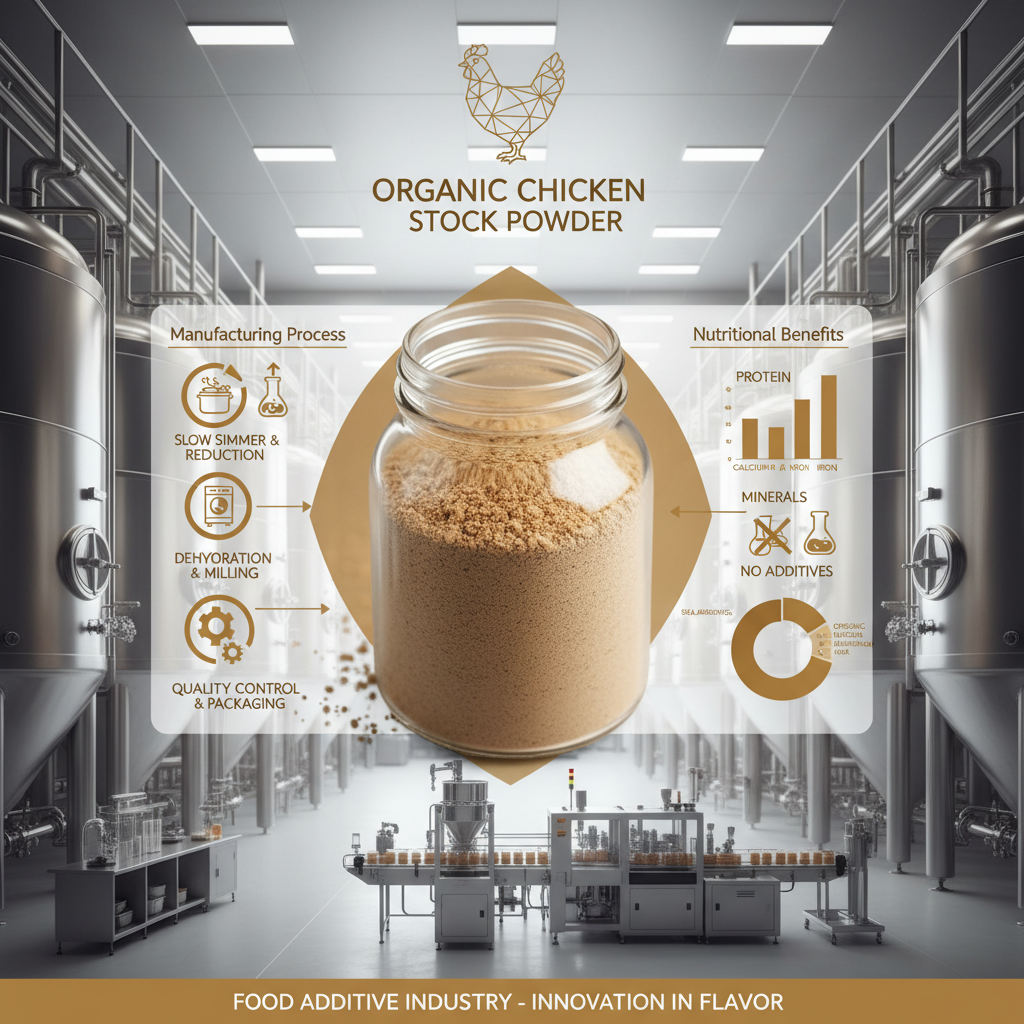
The quality of organic chicken stock powder is primarily determined by its "Umami Density." This is achieved through the slow simmering of organic carcasses, which extracts collagen and glutamates, providing the characteristic mouthfeel and depth of flavor that defines a premium stock.
Another pivotal factor is the purity of the organic carrier agents. To maintain a free-flowing powder, manufacturers often use organic maltodextrin or rice flour. The choice of carrier impacts the solubility of the organic chicken stock powder in hot water, ensuring there are no clumps or residues in the final culinary application.
Finally, the stability of the lipid profile is crucial. Since chicken stock contains natural fats, the powder must be processed to prevent oxidation. Using organic-approved antioxidants, such as rosemary extract, ensures that the product remains fresh and free from off-flavors during its extended shelf life.
Practical Applications in the Global Food Industry
The versatility of organic chicken stock powder allows it to permeate various sectors of the food industry. In the Ready-to-Eat (RTE) meal sector, it provides a consistent flavor base for organic soups and stews, allowing brands to scale production without sacrificing the "homemade" taste. In the snack food industry, it is used as a seasoning dust for organic chips and crackers, providing a savory punch that appeals to adults and children alike.
Moreover, the pharmaceutical and nutraceutical industries are exploring these organic concentrates as flavor masks for protein-based supplements. By integrating a mild, savory note, they can make nutritional shakes or recovery meals more palatable for patients with appetite loss, demonstrating the product's utility beyond traditional cooking.
Efficiency Comparison of Organic Chicken Stock Powder Formulations
Long-term Value and Sustainability Benefits
Investing in organic chicken stock powder offers significant long-term economic and environmental value. By utilizing organic-certified poultry, manufacturers support regenerative farming practices that improve soil health and reduce water pollution. This alignment with ESG (Environmental, Social, and Governance) goals enhances brand equity, as modern consumers are more likely to remain loyal to companies that demonstrate a commitment to planetary health.
From a logical operational standpoint, the reliability of a powdered format reduces waste. Liquid stocks are prone to spoilage and require expensive refrigerated transport; in contrast, the powder's stability minimizes losses due to expiration and optimizes warehouse space. This efficiency translates directly into lower overhead costs and a more resilient supply chain, ensuring that the brand can maintain price stability despite fluctuations in raw material costs.
Future Innovations in Organic Dehydration Tech
The future of organic chicken stock powder lies in the adoption of "Cold-Plasma" and "Advanced Lyophilization" (freeze-drying) technologies. These innovations allow for the removal of moisture at temperatures that preserve the heat-sensitive vitamins and delicate aroma compounds of the organic chicken, resulting in a powder that is virtually identical to fresh stock upon rehydration.
Furthermore, we are seeing a move toward "Digital Traceability." By integrating blockchain technology into the production of organic seasonings, manufacturers can provide consumers with a QR code that traces the chicken from the specific organic farm to the final powdering plant. This level of transparency is becoming a prerequisite for entry into the highest tiers of the organic market.
Automation is also playing a key role. AI-driven sensory analysis is now being used to monitor the "umami profile" in real-time during the simmering process, automatically adjusting heat and timing to ensure every batch of organic chicken stock powder meets a precise flavor benchmark, eliminating human error and reducing batch variance.
Challenges and Strategic Solutions in Sourcing
One of the primary hurdles in the production of organic chicken stock powder is the volatility of the organic poultry supply. Since organic chickens grow slower and require specific feed, the availability of carcasses can fluctuate seasonally. To mitigate this, leading manufacturers are establishing direct, long-term contracts with organic cooperatives, ensuring a steady flow of raw materials while providing farmers with financial security.
Another challenge is the strict prohibition of certain synthetic anti-caking agents. To solve this, R&D teams are experimenting with organic-compliant minerals and botanical fibers that prevent clumping without altering the taste. This commitment to "Clean Label" innovation allows companies to satisfy both regulatory auditors and the most discerning consumers.
Lastly, navigating the disparate organic certifications across different countries (e.g., USDA vs. JAS vs. EU) can be a logistical nightmare. The solution lies in adopting a "Global Standard" approach, where the product is manufactured to the most stringent available certification, ensuring the powder can be exported to any market without the need for costly reformulations.
Comparison of Organic Chicken Stock Powder Sourcing and Production Metrics
| Sourcing Strategy |
Cost Impact |
Quality Stability |
Certification Ease |
| Direct Farm Contract |
Medium (Stable) |
High (9/10) |
Excellent |
| Spot Market Purchase |
Low (Volatile) |
Low (5/10) |
Difficult |
| Organic Co-ops |
Medium |
Medium (7/10) |
Good |
| Integrated Supply Chain |
High (Initial) |
Very High (10/10) |
Seamless |
| Third-Party Aggregators |
Medium |
Medium (6/10) |
Moderate |
| Imported Organic Raws |
High (Logistics) |
Variable (7/10) |
Complex |
FAQS
The superiority lies in the purity of the ingredients and the production process. Organic versions eliminate synthetic MSG, artificial dyes, and chemically processed salts, replacing them with natural umami sources from organic poultry and vegetables. This results in a cleaner taste profile and aligns with health-conscious dietary needs, providing a nutrient-dense alternative without the risk of pesticide residues.
When stored in a cool, dry place in airtight packaging, high-quality organic chicken stock powder typically maintains its peak flavor for 12 to 24 months. To maximize shelf life, manufacturers often use organic-approved antioxidants like rosemary extract and vacuum-sealed foil packaging to prevent lipid oxidation and moisture absorption, ensuring the product remains free-flowing and aromatic.
Absolutely. In fact, it is designed for industrial scalability. It provides a standardized flavor base that ensures every batch of a commercial product tastes identical, which is nearly impossible to achieve using fresh stock. Its high solubility and concentrated nature make it ideal for large-scale soup bases, seasoning blends, and snack coatings while maintaining a "clean label" certification.
No, as it is derived from organic chicken, it is not vegan. However, for manufacturers operating multi-category lines, we recommend strict cleaning protocols and dedicated equipment to avoid cross-contamination. If a vegan alternative is needed, we suggest looking into organic mushroom-based savory powders which offer a similar umami profile.
Modern dehydration techniques, especially freeze-drying or low-temperature spray drying, preserve the vast majority of the proteins and minerals found in the original stock. While some heat-sensitive vitamins may decrease slightly, the concentration of collagen and amino acids remains high, making it a highly efficient way to deliver savory nutrition.
Verification should be done through the Certificate of Analysis (COA) and the organic certification seal (such as USDA, EU, or JAS) provided by the manufacturer. We recommend requesting a traceability report that lists the origin of the poultry and the processing plant's certification number, which can be cross-referenced with the official organic database of the certifying body.
Conclusion
The adoption of organic chicken stock powder represents a strategic evolution in the food additives industry, marrying the demand for organic purity with the necessity of industrial efficiency. By focusing on umami density, clean-label carriers, and sustainable sourcing, manufacturers can deliver a product that satisfies both the palate of the gourmet chef and the rigorous standards of organic certification. The long-term value extends beyond simple taste, encompassing environmental sustainability, supply chain resilience, and enhanced brand trust.
Looking forward, the integration of advanced dehydration technologies and blockchain traceability will further solidify the position of organic concentrates in the global market. For companies aiming to capture the premium "healthy-convenience" segment, transitioning to high-quality organic bases is no longer optional but a competitive imperative. We invite you to explore our professional-grade solutions and elevate your product line. Visit our website: www.chinaseasoning.com