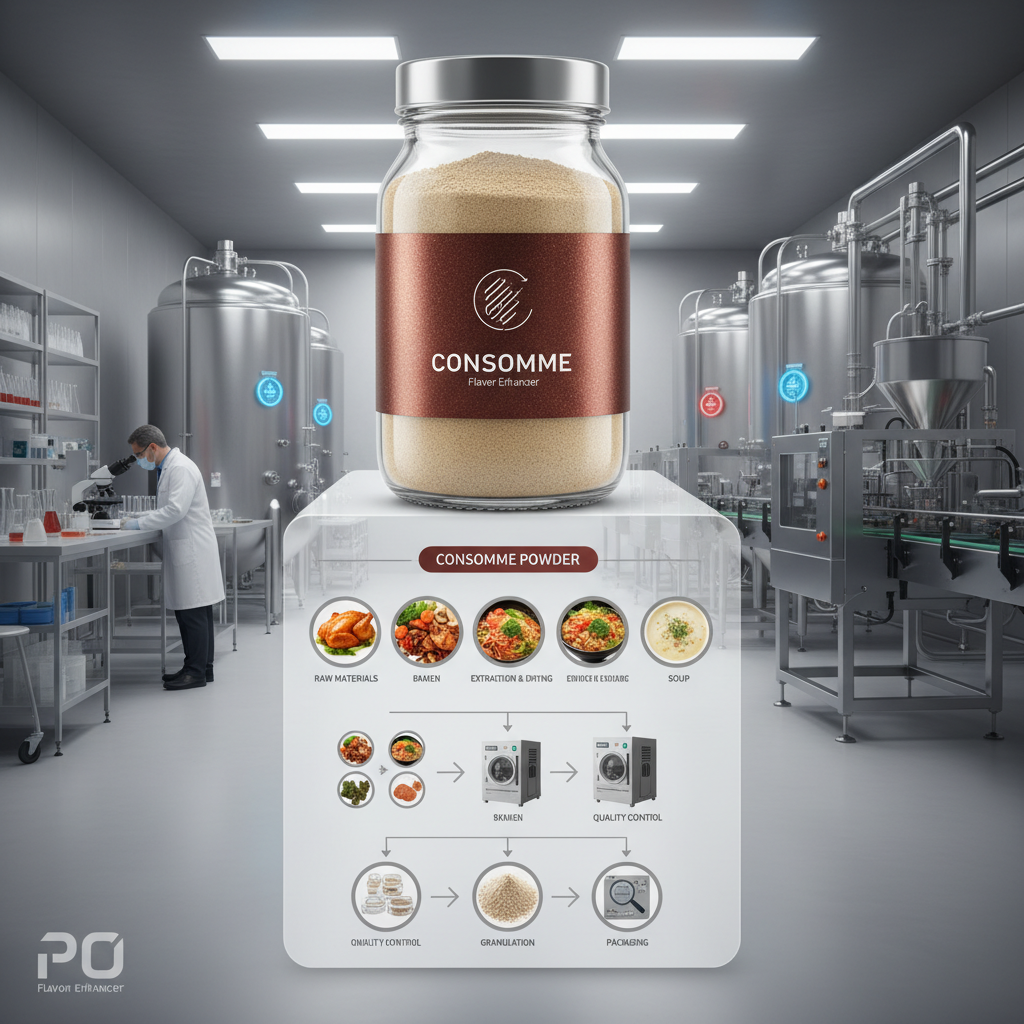
In the sophisticated world of culinary additives, consomme powder represents a pinnacle of convenience and flavor concentration. Traditionally, a consommé is a clarified broth that requires hours of simmering and a precise "raft" of egg whites and minced meat to remove impurities. However, the industrialization of food additives has transformed this laborious process into a seamless application, allowing professional chefs and home cooks alike to achieve crystal-clear, rich-tasting stocks in seconds.
The global demand for high-quality bouillon and base powders has surged as the fast-paced nature of modern dining demands consistency without sacrificing the gourmet quality of traditional French cuisine. By utilizing advanced spray-drying and granulation technologies, consomme powder provides a stable, shelf-ready solution that retains the volatile aromatic compounds of slow-cooked meats and vegetables, bridging the gap between artisanal quality and industrial scalability.
Understanding the chemistry and application of these powders is essential for food manufacturers and distributors. From optimizing the salt-to-umami ratio to ensuring complete solubility in high-temperature liquids, the science behind consomme powder impacts everything from the cost-per-serving in large-scale catering to the sensory experience of a luxury dinner.
Global Market Relevance of Consomme Powder
The global flavor enhancer market has seen a significant shift toward dehydrated formats, with consomme powder leading the charge in the premium savory segment. According to food industry trends aligned with ISO standards for food safety and quality, the transition from liquid bases to concentrated powders has reduced logistics costs by up to 40% due to the elimination of water weight and the reduction of cold-chain requirements.
As urban populations grow and the "ready-to-eat" (RTE) sector expands, the challenge for manufacturers is to maintain the "clean label" expectation while providing an intense, clarified flavor profile. The industry is currently grappling with the balance between sodium reduction and the preservation of the deep, savory notes that define a traditional consommé, making the development of high-efficacy powders a priority for global food conglomerates.
Defining the Composition of Consomme Powder
At its core, consomme powder is a complex mixture of hydrolyzed proteins, maltodextrins, salt, and natural aromatic extracts. Unlike standard bouillon cubes, which often rely heavily on fat and fillers, a true consommé powder focuses on clarity and an intense "umami" punch. It is designed to dissolve completely in hot water without leaving a cloudy residue, mimicking the result of a meticulous clarification process.
In the context of modern food additive manufacturing, this powder serves a critical humanitarian and industrial need by providing nutrient-dense, flavor-rich bases for institutional feeding programs and emergency food rations. The ability to stabilize these flavors in a dry state ensures that high-quality nutrition can be transported to remote areas without the risk of spoilage associated with liquid stocks.
The synergy between the pharmaceutical-grade intermediates used for flavor stability and the food-grade additives ensures that the product remains free-flowing (anti-caking) while maintaining a potent olfactory profile. This precision engineering allows the powder to act as a versatile foundation for soups, sauces, and glazes in professional kitchens worldwide.
Key Performance Factors in Powder Quality
The first critical factor in the efficacy of consomme powder is its solubility. A high-grade powder must exhibit rapid dispersion in water at varying temperatures, ensuring that no clumps remain. This is achieved through precise particle size distribution and the use of high-quality carriers that prevent the active flavor components from aggregating.
Secondly, flavor stability is paramount. The volatility of meat and vegetable essences means that consomme powder must be encapsulated or stabilized to prevent oxidation. This ensures that the product tastes as fresh on the day of use as it did on the day of manufacture, maintaining the deep, amber hue and savory aroma that consumers expect.
Finally, cost-efficiency and scalability are the drivers for industrial adoption. By optimizing the ratio of expensive protein extracts to functional fillers, manufacturers can produce a consomme powder that is economically viable for mass-market distribution while still meeting the rigorous sensory standards of the food industry.
Industrial Applications and Versatility
The application of consomme powder extends far beyond simple soup preparation. In the commercial food sector, it is utilized as a seasoning base for savory snacks, a flavor enhancer for processed meats, and a thickening agent in high-end sauces. Its ability to provide a consistent taste profile makes it indispensable for franchise restaurants that require the same flavor experience across thousands of locations globally.
In specialized contexts, such as remote industrial zones or post-disaster relief operations, these powders are used to fortify bland staples with essential nutrients and palatable flavors. The logistical advantage of a powder—low weight, high stability, and ease of use—allows NGOs and government agencies to provide dignified, flavorful meals to populations in crisis.
Efficiency Analysis of Various Consomme Powder Formulations
Long-term Value and Economic Advantages
The shift toward consomme powder offers tangible economic benefits through waste reduction. Traditional stock production involves significant water loss and the disposal of large amounts of organic waste (the "raft"). By using a concentrated powder, kitchens can eliminate the risk of batch failure and dramatically reduce the energy consumption associated with hours of boiling.
Beyond the balance sheet, the use of stabilized powders enhances operational reliability. In high-pressure culinary environments, the trust that a specific measurement of consomme powder will produce the exact same flavor profile every time allows for better menu planning and higher customer satisfaction, fostering long-term brand loyalty and trust.
Future Innovations in Flavor Technology
The future of consomme powder is being shaped by the rise of biotechnology and sustainable sourcing. We are seeing a movement toward "clean-label" formulations where synthetic flavor enhancers are replaced by fermented yeast extracts and mushroom-based umami compounds. This shift not only appeals to health-conscious consumers but also aligns with global sustainability goals to reduce the carbon footprint of meat production.
Digital transformation is also playing a role in the manufacturing process. Automation and AI-driven sensory analysis are now used to tweak the composition of consomme powder in real-time, ensuring that the batch-to-batch variance is virtually zero. This level of precision allows for the creation of highly customized blends tailored to specific regional palates—such as a saltier profile for East Asian markets or a more herbal profile for European markets.
Furthermore, the integration of green energy in spray-drying towers is reducing the environmental impact of production. By utilizing closed-loop water systems and solar-thermal energy, the manufacturing of consomme powder is becoming a benchmark for eco-friendly food additive production, proving that gourmet quality does not have to come at an environmental cost.
Overcoming Technical Challenges in Production
Despite its benefits, the production of consomme powder faces hurdles, primarily regarding hygroscopicity. Because the powder contains salts and sugars, it naturally attracts moisture from the air, which can lead to caking and loss of flowability. Expert solutions involve the use of advanced nano-coatings or the addition of food-grade silica to ensure the powder remains free-flowing even in humid warehouse conditions.
Another challenge is the "burnt" note often associated with high-temperature drying. To overcome this, manufacturers are implementing low-temperature vacuum drying and freeze-drying techniques. While more expensive, these methods preserve the delicate top-notes of the ingredients, ensuring that the consomme powder delivers a fresh, nuanced taste rather than a processed, industrial one.
Finally, achieving total clarity upon reconstitution requires a precise balance of surfactants and stabilizers. By utilizing pharmaceutical-grade intermediates, chemists can ensure that the fats are perfectly emulsified or removed, resulting in a liquid that is aesthetically transparent but flavor-dense.
Comparative Analysis of Consomme Powder Production Methods
| Production Method |
Flavor Retention |
Solubility Rate |
Production Cost |
| Spray Drying |
Moderate |
High |
Low |
| Freeze Drying |
Excellent |
Very High |
Very High |
| Vacuum Drying |
High |
Moderate |
Moderate |
| Drum Drying |
Low |
Low |
Very Low |
| Hybrid Granulation |
High |
High |
Moderate |
| Cold-Press Dehydration |
Very High |
Moderate |
High |
FAQS
Consomme powder is specifically engineered for clarity and a refined, concentrated flavor profile, mimicking a clarified broth. Regular bouillon is often cloudier, contains more fat, and uses heavier fillers, making it suitable for stews but less ideal for clear gourmet soups or sauces.
To maintain the free-flowing nature of the powder, it should be stored in an airtight container in a cool, dry place. For industrial scales, utilizing powder with professional anti-caking agents and climate-controlled warehousing is recommended to prevent moisture absorption.
Yes, provided the formulation uses plant-based proteins and yeast extracts instead of meat derivatives. Many modern manufacturers offer vegan versions of consomme powder that use mushroom and sea-vegetable extracts to replicate the deep umami taste of beef or chicken.
High solubility ensures that the flavor is evenly distributed without grit or residue. In professional culinary applications, this allows for a crystal-clear appearance, which is the hallmark of a true consommé, ensuring the visual appeal of the dish remains intact.
Yes, by incorporating potassium salts or enhancing the concentration of natural glutamates (like those found in kombu or shiitake), manufacturers can create low-sodium consomme powder that still delivers a powerful savory experience.
Scaling is achieved by using standardized dosing systems and pre-mix ratios. By switching from liquid bases to powders, kitchens can reduce storage space requirements and ensure consistency across multiple shifts and locations through precise weighing.
Conclusion
The evolution of consomme powder represents a perfect marriage of traditional culinary art and modern food science. By solving the challenges of stability, solubility, and scalability, these powders provide an indispensable tool for the global food industry, allowing for the delivery of high-end flavor profiles with unmatched efficiency and reliability.
Looking forward, the industry will likely continue to move toward cleaner, more sustainable formulations that prioritize health without compromising the sensory experience. For businesses looking to elevate their product offerings or optimize their kitchen operations, investing in high-quality, scientifically-formulated savory bases is a strategic move toward excellence. Visit our website: www.chinaseasoning.com