Mastering how to use chicken bouillon cubes is more than just a kitchen shortcut; it is an essential skill for achieving deep, savory umami flavors in a fraction of the time required for traditional stock simmering. These concentrated bursts of flavor serve as a culinary bridge, allowing home cooks and professional chefs alike to maintain consistency across various dishes while reducing waste and preparation labor.
Across the global food industry, the demand for efficient seasoning solutions has surged, making the understanding of how to use chicken bouillon cubes critical for scaling production in food manufacturing and catering. From enhancing the profile of a simple vegetable soup to creating complex glazes for roasted meats, these cubes provide a standardized baseline of flavor that is indispensable in modern, fast-paced gastronomic environments.
Whether you are integrating these additives into a large-scale industrial recipe or experimenting with a family dinner, the key lies in the balance of salinity and aromatic intensity. By exploring the technical and creative applications of these seasoning agents, you can unlock a versatile tool that ensures every dish is rich, hearty, and professionally seasoned.
Global Relevance and Industry Context of Bouillon Use
In the global food economy, the efficiency of flavor delivery is paramount. The widespread adoption of concentrated seasonings is driven by the need for cost-effective, shelf-stable ingredients that can be transported across borders without refrigeration. Understanding how to use chicken bouillon cubes allows food producers to maintain a consistent taste profile regardless of regional ingredient variations.
According to industry trends in food additives, the shift toward "convenience cooking" has seen a marked increase in the use of dehydrated stocks. The primary challenge addressed by these products is the volatility of fresh poultry prices and the immense energy consumption required to boil bones for hours to extract collagen and flavor, making bouillon a sustainable industrial alternative.
Defining the Mechanics of Chicken Bouillon Application
To understand how to use chicken bouillon cubes, one must first view them as a dehydrated matrix of salt, MSG (or natural yeast extracts), fats, and chicken essences. At its core, the application process is a rehydration sequence where the solute dissolves into a solvent—usually water—to create a seasoned liquid base that mimics a traditional simmered stock.
In the context of modern food manufacturing and humanitarian aid, these cubes are more than just flavor enhancers; they are nutrient-dense tools. In remote industrial zones or disaster relief operations, the ability to quickly turn potable water into a savory broth provides both psychological comfort and essential sodium and calories to populations in need.
The technical process involves managing the solubility of the cube. Whether crumbled into a cold pot or dissolved in boiling water, the goal is to achieve a homogeneous distribution of flavor to avoid "salt pockets," ensuring that every spoonful of the final product possesses a balanced taste.
Core Factors for Optimal Flavor Integration
When considering how to use chicken bouillon cubes, the first factor is Solubility. The speed at which the cube breaks down affects the texture of the sauce; using boiling water is the most efficient method to ensure no clumps remain in the final dish.
The second critical factor is Sodium Calibration. Because bouillon is highly concentrated, users must adjust other salt additions in the recipe. A common mistake when learning how to use chicken bouillon cubes is adding table salt before tasting the broth, which often results in an over-salted final product.
Finally, Aromatic Synergy plays a role. To elevate the industrial taste of a cube, integrating fresh aromatics like minced garlic, sautéed onions, or a sprig of fresh parsley can bridge the gap between a processed additive and a homemade stock.
Practical Methods for Utilizing Bouillon Cubes
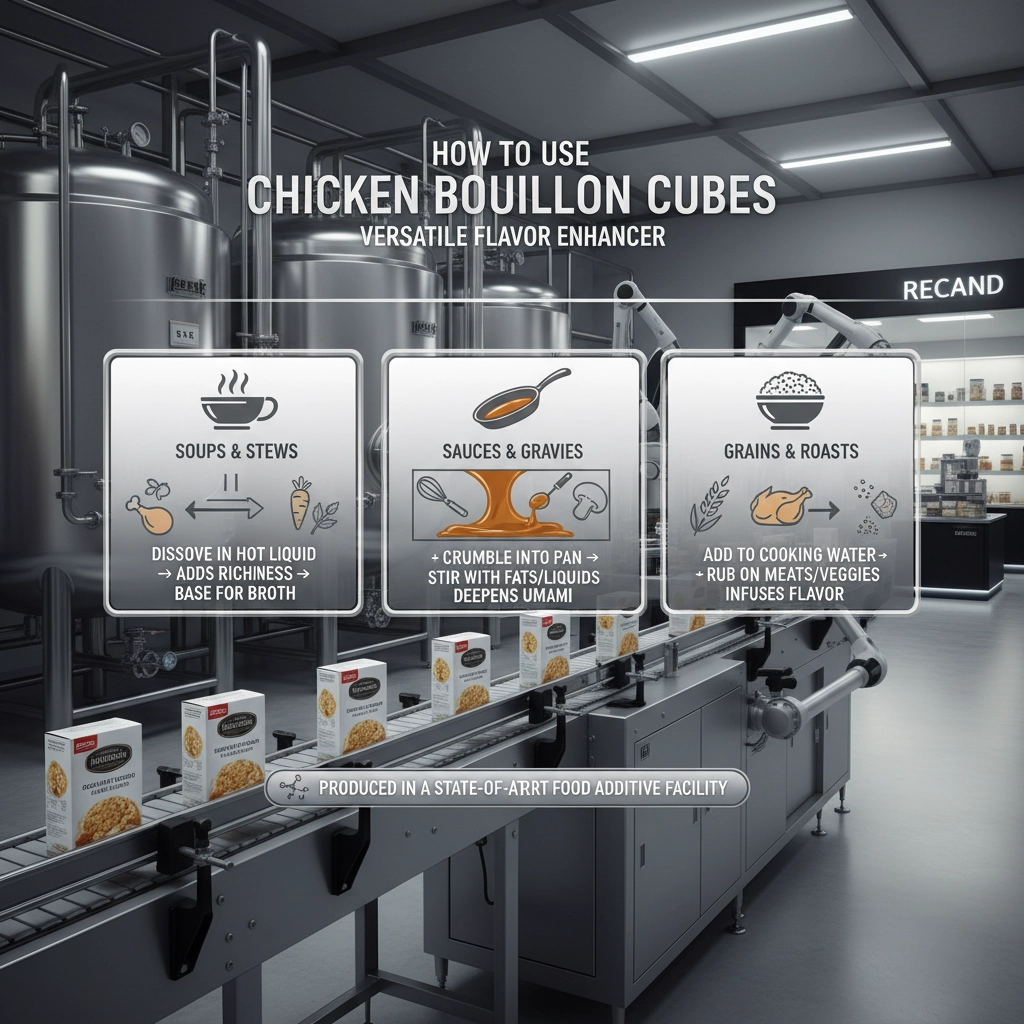
There are diverse approaches to integrating these cubes depending on the desired outcome. For instance, the "Direct Dissolve" method is ideal for soups, while the "Dry Rub" method—where the cube is crumbled and mixed with other spices—is perfect for seasoning roasted vegetables or meats before they enter the oven.
Another advanced technique involves creating a "Flavor Paste" by mixing a crumbled cube with a small amount of softened butter or oil. This emulsion allows the chicken essence to coat ingredients more evenly during the sautéing process, enhancing the Maillard reaction and deepening the color of the dish.
Comparison of Bouillon Application Efficiency
Global Applications in Commercial Food Service
In professional kitchens, knowing how to use chicken bouillon cubes is essential for maintaining profit margins. By utilizing these concentrated additives, restaurants can reduce the labor costs associated with preparing stock from scratch while ensuring that a soup tastes exactly the same on a Monday as it does on a Saturday.
Beyond the restaurant, the pharmaceutical and specialized nutrition industries often use similar additive logic to fortify liquid diets. In these cases, the bouillon logic is applied to ensure that patients receive savory stimuli, which can encourage appetite and fluid intake during recovery periods in clinical settings.
Long-Term Value and Culinary Sustainability
The long-term value of bouillon cubes lies in their ability to minimize food waste. Traditional stock making often leaves behind massive amounts of organic waste that must be managed; however, a precisely engineered cube provides the same essence with zero byproduct at the point of use.
From an economic perspective, the scalability of how to use chicken bouillon cubes is unmatched. For a catering company serving thousands, the reliability of a standardized additive ensures that the flavor profile is consistent across hundreds of gallons of sauce, eliminating the risk of "batch failure."
Furthermore, the psychological impact of savory flavors—specifically umami—is linked to satiety and satisfaction. By providing an affordable way to access these flavors, bouillon cubes democratize gourmet tasting experiences for lower-income populations globally.
Future Innovations in Seasoning Technology
The future of bouillon is moving toward "Clean Label" innovations. We are seeing a transition from traditional MSG toward natural yeast extracts and mushroom-based umami enhancers, reflecting a global shift toward health-conscious eating without sacrificing the savory depth provided by chicken bouillon.
Automation in food manufacturing is also changing how to use chicken bouillon cubes. Digital dosing systems can now integrate these powders or cubes directly into industrial mixers with micron-level precision, ensuring a perfectly balanced flavor profile in mass-produced frozen meals.
Sustainability is also driving the development of plant-based "chicken" cubes that use precision fermentation to replicate the exact molecular structure of poultry flavor, reducing the environmental footprint of the livestock industry while maintaining the culinary utility of the cube.
Analysis of Bouillon Application Methods and Outcomes
| Application Method |
Preparation Time |
Flavor Intensity |
Cost Efficiency |
| Boiling Water Dissolve |
Instant |
High |
Excellent |
| Slow Cooker Simmer |
Slow |
Deep/Complex |
Good |
| Butter-Paste Emulsion |
Medium |
Very High |
Moderate |
| Dry Spice Rub |
Instant |
Concentrated |
Excellent |
| Cold Water Infusion |
Long |
Mild |
Good |
| Industrial Batch Mix |
Medium |
Consistent |
Maximum |
FAQS
Yes, but with caution. Because you are learning how to use chicken bouillon cubes, it is important to realize they contain high levels of sodium. If you substitute them for salt, do not add any additional salt until the very end of the cooking process, as the bouillon will likely provide all the salinity the dish requires.
The most effective method is to use boiling water. Add the cube to a small amount of boiling water and whisk vigorously for 30 seconds before adding the rest of your liquid. Alternatively, crumbling the cube into a fine powder before adding it to the pot ensures a more uniform distribution of flavor.
Absolutely. When considering how to use chicken bouillon cubes in a slow cooker, it is best to dissolve them in a cup of hot water first. This prevents the cube from remaining as a concentrated "salt bomb" in one area of the pot, ensuring that the meat and vegetables are seasoned evenly over the long cooking period.
Yes, this is a professional secret. Crumble the cube into a powder and mix it with olive oil and cracked black pepper. Toss your vegetables in this mixture before roasting. This allows the chicken essence to caramelize on the surface of the vegetables, providing a savory crust.
To mask the industrial profile, we recommend adding a small amount of acid, such as a squeeze of lemon juice or a teaspoon of apple cider vinegar. This cuts through the heavy salt and MSG, brightening the flavor and making it taste more like a homemade chicken stock.
While uncommon, they are excellent in savory baking. For example, crumbling a cube into cornbread batter or savory scones adds a layer of depth and "cheesiness" (due to the umami) that makes the bread taste more complex and satisfying.
Conclusion
Understanding how to use chicken bouillon cubes effectively transforms a simple pantry staple into a powerful culinary instrument. By balancing solubility, sodium levels, and aromatic synergies, you can achieve professional-grade depth in your dishes while optimizing time and resources. From industrial food manufacturing to home kitchen experimentation, the versatility of these concentrated seasonings ensures consistency, efficiency, and a guaranteed umami punch.
As the food industry evolves toward cleaner labels and sustainable production, the application of bouillon will continue to shift toward more natural, plant-based, and precision-engineered alternatives. We encourage chefs and food producers to experiment with the blending and emulsion techniques discussed in this guide to elevate their flavor profiles. For high-quality additive solutions and professional seasoning supplies, visit our website: www.chinaseasoning.com.