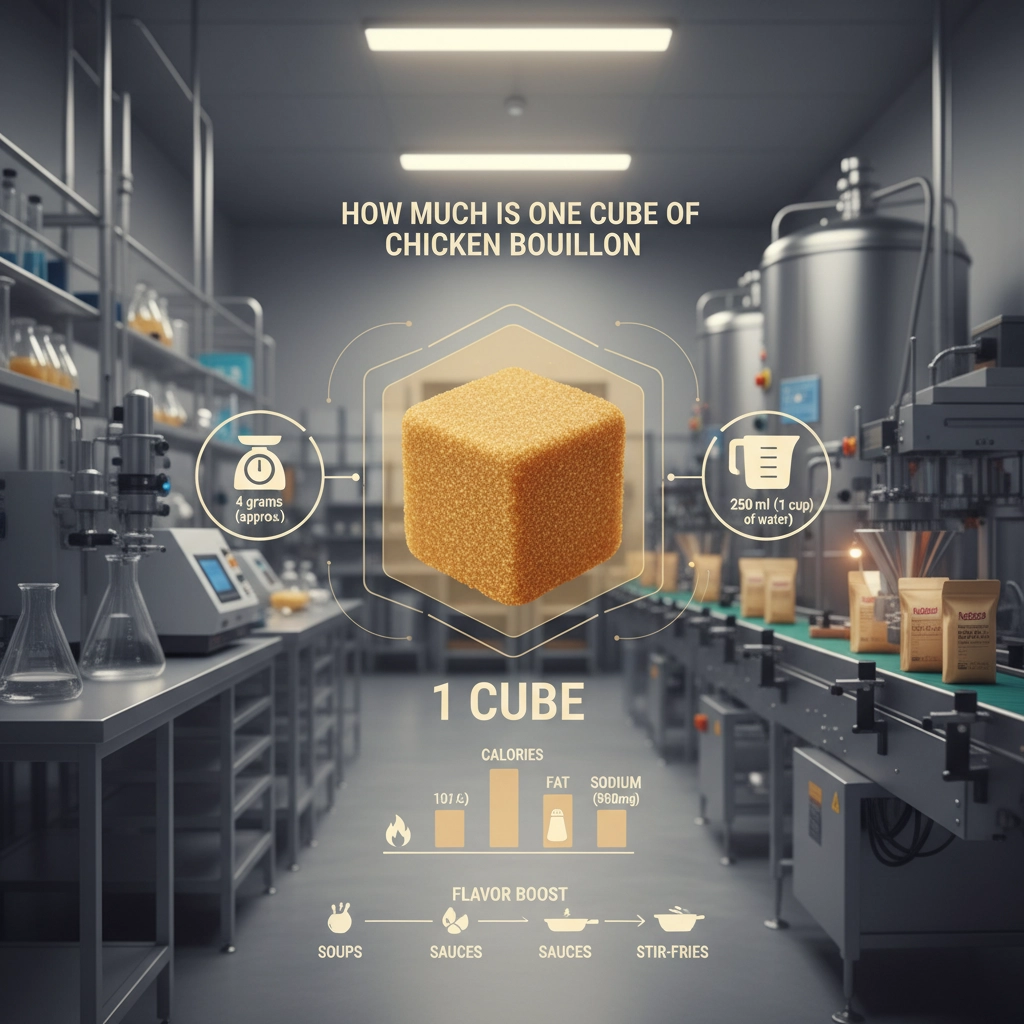
When entering the world of culinary efficiency and industrial food production, a common question arises for both home cooks and procurement managers: how much is one cube of chicken bouillon in terms of flavor concentration and economic value? Understanding the potency of a single bouillon cube is essential for maintaining taste consistency across large batches of food, ensuring that the salt and umami levels remain balanced.
From a global supply chain perspective, the cost-effectiveness of these concentrated flavor enhancers makes them indispensable. Whether used in household kitchens or large-scale food manufacturing, knowing how much is one cube of chicken bouillon helps in calculating precise ingredient costs and reducing waste during the production of soups, sauces, and stews.
Moreover, the evolution of food additives has transformed the humble bouillon cube into a sophisticated blend of maltodextrin, salt, and hydrolyzed vegetable proteins. Analyzing how much is one cube of chicken bouillon allows industry professionals to optimize their formulations for better scalability and shelf-stability in diverse climatic conditions.
The Economic Value of One Cube of Chicken Bouillon
When we analyze how much is one cube of chicken bouillon from an economic standpoint, we aren't just looking at the retail price, but the "cost per serving." A single cube typically replaces a significant amount of fresh chicken stock, reducing the need for expensive raw materials and long simmering times.
This efficiency is why bouillon cubes are a staple in the food additive industry. By condensing the essence of chicken flavor into a small, stable format, manufacturers provide a high-value product that minimizes shipping costs and maximizes storage space, effectively lowering the overhead for food service operators.
Industrial Standards for Bouillon Concentration
To understand how much is one cube of chicken bouillon in terms of potency, one must look at ISO and food safety standards. Most industrial cubes are designed to flavor approximately 500ml to 1 liter of water, creating a standardized salinity and flavor profile that is consistent across millions of units.
This standardization is critical for the pharmaceutical and food additive sectors. When a recipe calls for a specific amount of seasoning, the precision of the bouillon cube ensures that the final product tastes the same whether it is produced in a kitchen in New York or a factory in Shanghai.
The challenge for manufacturers is balancing the concentration. If the cube is too potent, it becomes difficult to integrate into delicate dishes; if it is too weak, the value proposition of "how much is one cube" diminishes, forcing the end-user to use more product and increasing their costs.
Key Components Affecting the Cost of Bouillon
Determining how much is one cube of chicken bouillon requires a look at its ingredient matrix. The primary drivers of cost are the quality of the chicken extract, the type of salt used, and the inclusion of flavor enhancers like MSG or yeast extract.
Beyond the basic flavor, the binding agents that allow the powder to hold a cube shape significantly influence the production cost. These additives ensure that the product doesn't crumble during transport, maintaining the integrity of the "single cube" unit of measurement.
Furthermore, organic certifications and "clean label" requirements have changed the equation of how much is one cube of chicken bouillon. Removing artificial colors and preservatives often increases the price point but adds immense value for health-conscious consumer markets.
Scalability and Efficiency in Commercial Use
In large-scale food production, the question of how much is one cube of chicken bouillon translates to "how many units per thousand gallons." The scalability of bouillon allows chefs to quickly pivot their production volumes without risking the flavor profile of their signature bases.
The use of these concentrated blocks eliminates the variance found in natural stocks, which can fluctuate based on the quality of the bird or the length of the boil. This reliability is the cornerstone of the food additive industry's success.
Efficiency Ratings of Different Bouillon Formats
Global Applications of Concentrated Seasoning
The utility of understanding how much is one cube of chicken bouillon extends to humanitarian aid and disaster relief. In regions where fresh water and refrigeration are scarce, these cubes provide a critical source of salt and flavor, making bland emergency grains palatable and nutritionally stimulating.
Similarly, in remote industrial zones or military deployments, the compact nature of bouillon cubes ensures that personnel can maintain a sense of dietary normalcy. The ability to transport thousands of "flavor units" in a small crate is a logistical triumph of food science.
Long-Term Value of Standardized Flavor Cubes
From a long-term perspective, the value of how much is one cube of chicken bouillon lies in its sustainability. By reducing the amount of water used in the transport of stocks (since cubes are anhydrous), the carbon footprint of seasoning distribution is significantly lowered.
Furthermore, the reliability of these products builds trust between the manufacturer and the commercial kitchen. When a chef knows exactly how much flavor one cube provides, they can innovate with confidence, knowing the baseline of their dish is secure.
This stability leads to higher profit margins for food businesses, as they can accurately predict their food cost percentages without worrying about the volatility of fresh produce prices.
Future Trends in Bouillon Manufacturing
The future of how much is one cube of chicken bouillon is being reshaped by digital transformation and automation. AI-driven formulation is now allowing manufacturers to create "hyper-concentrated" cubes that offer more flavor with less mass, further reducing shipping costs.
Sustainability is also driving a shift toward plant-based "chicken" bouillon. By using advanced fermentation and pea proteins, the industry is creating cubes that mimic the exact flavor profile of chicken while appealing to the vegan market and reducing the environmental impact of livestock farming.
As we move toward 2030, we expect to see smart packaging that monitors the freshness of these additives, ensuring that the potency of every single cube remains peak from the factory to the pot.
Comparative Analysis of Bouillon Formulations and Market Value
| Product Grade |
Concentration Level |
Cost per Unit |
Market Application |
| Economy Grade |
Medium |
Low |
Mass Market / Retail |
| Professional Grade |
High |
Medium |
Restaurants / Catering |
| Organic Premium |
Medium-High |
High |
Health Food Stores |
| Industrial Bulk |
Very High |
Very Low |
Food Factories |
| Vegan Alternative |
High |
Medium-High |
Plant-based Markets |
| Low-Sodium Spec |
Medium |
Medium |
Medical / Dietetic |
FAQS
Generally, one cube is designed to be dissolved in 500ml to 1 liter of boiling water. In industrial applications, this ratio is strictly maintained to ensure that the sodium and flavor levels remain consistent across different production batches, avoiding over-seasoning.
Bouillon cubes are significantly more cost-effective due to their concentrated nature. They eliminate the cost of transporting water and have a much longer shelf life, which reduces waste and storage costs for large-scale food manufacturers.
The price varies based on the percentage of real chicken extract versus fillers like maltodextrin. Premium cubes use higher concentrations of natural extracts and avoid artificial dyes, which increases the cost per unit but improves the final taste profile.
Yes, typically one cube is equivalent to about 1 tablespoon of bouillon powder. However, the cube format is often preferred in professional settings for its ease of portion control and reduced risk of spillage during the measuring process.
Absolutely. Their anhydrous form reduces shipping weights and carbon emissions. Furthermore, the shift toward biodegradable wrappers and plant-based ingredients is making the bouillon cube an even more sustainable choice for the food industry.
The best approach is to partner with certified food additive manufacturers who comply with ISO and HACCP standards. Ensuring that the supplier provides detailed COA (Certificate of Analysis) for each batch ensures the potency of every cube is consistent.
Conclusion
In summary, understanding how much is one cube of chicken bouillon involves looking beyond the simple price tag to recognize its immense value in flavor concentration, logistical efficiency, and cost-saving potential. From its role in humanitarian aid to its application in the most sophisticated commercial kitchens, the bouillon cube remains a marvel of food engineering that balances taste, stability, and economy.
As the industry evolves toward cleaner labels and more sustainable production methods, the reliance on high-quality, standardized seasoning additives will only grow. For businesses looking to optimize their food costs without compromising on quality, investing in premium, consistently formulated bouillon products is a strategic necessity. Visit our website for more professional seasoning solutions: www.chinaseasoning.com