The process of converting chicken bouillon cubes to broth is a fundamental practice in both professional culinary arts and domestic kitchens worldwide. By condensing the essence of chicken, herbs, and salts into a stable, dehydrated cube, manufacturers provide a convenient shortcut to achieving a deep, savory base that would otherwise require hours of simmering. Understanding the chemistry and ratio behind this conversion is key to maintaining flavor consistency across large-scale food production.
Globally, the demand for concentrated seasoning has surged as the fast-paced nature of modern lifestyles demands efficiency without compromising on taste. The ability to rapidly transform chicken bouillon cubes to broth allows food service operators to scale their operations quickly, ensuring that every bowl of soup or sauce maintains a standardized flavor profile. This efficiency is particularly vital in the food additive industry, where precision in salt and glutamate levels determines the final product's success.
Beyond simple convenience, the science of reconstituting these cubes involves the interaction of hydrocolloids, flavor enhancers, and lipids. When we analyze the transition from chicken bouillon cubes to broth, we are looking at the rehydration of a complex matrix designed for long-term stability. This guide explores the industry standards, technical applications, and innovative trends that make this process essential for the global food supply chain.
Global Industry Context of Bouillon Conversion
In the global food manufacturing sector, the transition from chicken bouillon cubes to broth represents a critical intersection of logistics and gastronomy. Market data indicates that the dehydrated seasoning market has seen consistent growth, driven by the need for shelf-stable ingredients in emerging economies and the convenience trend in developed nations. ISO standards for food additives ensure that these cubes provide a consistent nutrient and flavor yield upon reconstitution.
However, a significant challenge remains in balancing the sodium content with the desired "umami" profile. Industry leaders are currently grappling with the "clean label" movement, where consumers demand the same efficiency in converting chicken bouillon cubes to broth but with fewer synthetic additives and lower salt levels. This shift is forcing a revolution in how bouillon is formulated at the molecular level.
Defining the Reconstitution Process
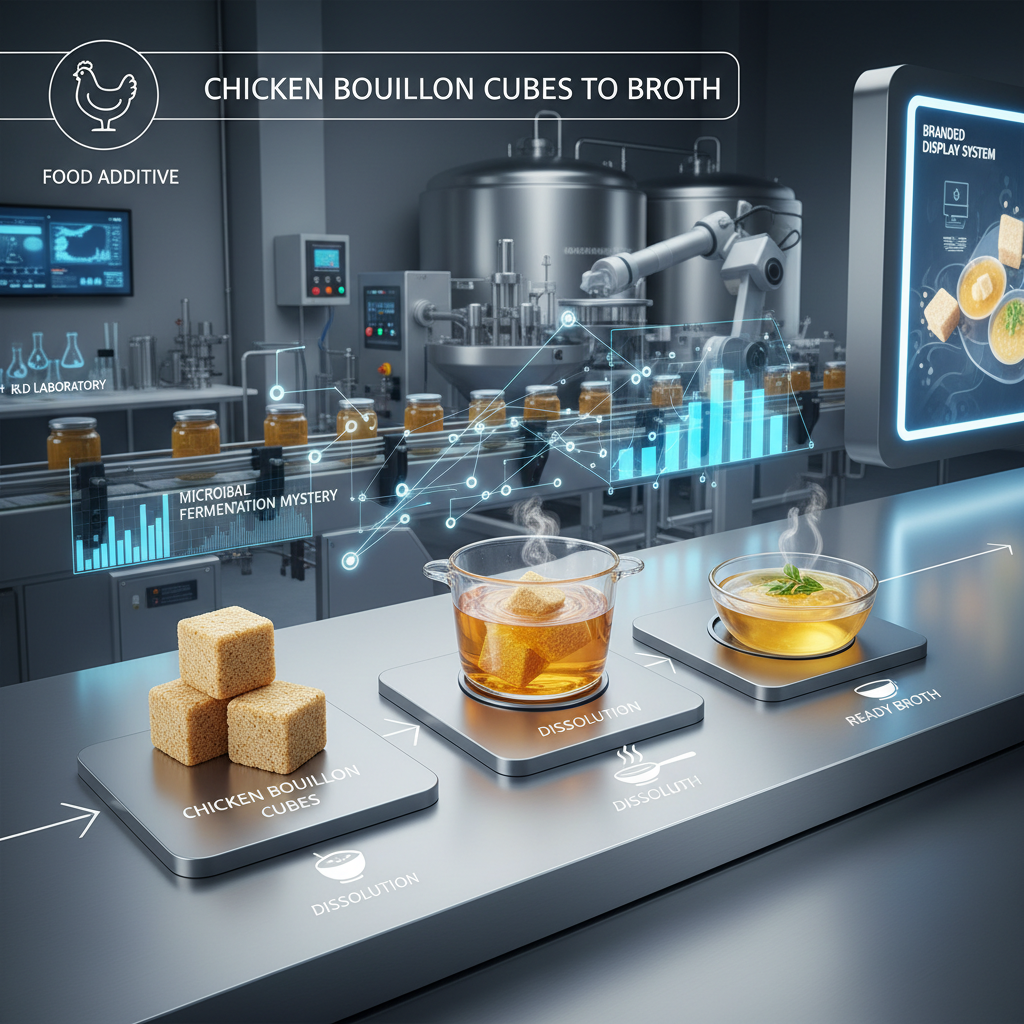
At its most basic level, converting chicken bouillon cubes to broth is the process of rehydration. The bouillon cube is a compressed block of salt, dehydrated chicken stock, flavor enhancers (such as MSG or yeast extract), and fats. When introduced to boiling water, these components dissolve and emulsify, recreating a liquid state that mimics a traditional slow-cooked stock.
This process is not merely about dissolving solids; it is about the restoration of a complex flavor matrix. The speed at which a cube dissolves determines its "instant" quality, a key metric in the food additive industry. A high-quality cube must transition from chicken bouillon cubes to broth without leaving clumps or uneven salt pockets, ensuring a homogenous liquid.
From a humanitarian perspective, this technology is indispensable. In disaster relief zones or remote industrial sites where fresh water and fresh meat are scarce, the ability to create nutrient-dense, flavorful liquids from compact cubes provides not only essential calories but also psychological comfort through familiar tastes.
Core Components of High-Quality Broth
The efficacy of converting chicken bouillon cubes to broth depends heavily on the quality of the base ingredients. Salt acts as both a flavor enhancer and a preservative, ensuring the cube remains stable across various climates. However, the depth of flavor comes from the hydrolyzed vegetable proteins and chicken extracts.
Another critical element is the use of emulsifiers and fats. To successfully transform chicken bouillon cubes to broth with a rich, mouth-filling texture, manufacturers incorporate stabilized fats that bloom when heated, creating the characteristic golden sheen of a natural chicken stock.
Finally, the inclusion of aromatic powders—such as onion, garlic, and parsley—adds the necessary olfactory dimension. When the transition from chicken bouillon cubes to broth occurs, these volatile compounds are released, providing the aromatic profile that defines a professional-grade culinary base.
Technical Factors in Flavor Scalability
Scalability is the primary driver for utilizing concentrated bases. In industrial kitchens, the ratio used to convert chicken bouillon cubes to broth must be precise to avoid over-salting large vats of liquid. This requires a deep understanding of the "solubility index" of the cube, ensuring that the flavor disperses evenly regardless of the volume of water.
Cost efficiency is another technical advantage. By transporting concentrated cubes rather than liquid broth, companies drastically reduce shipping weights and refrigeration costs. The energy required to convert chicken bouillon cubes to broth on-site is a fraction of the energy needed to transport and store pre-made liquid stocks.
Efficiency Analysis: Chicken Bouillon Cubes to Broth Methods
Global Applications and Use Cases
The application of converting chicken bouillon cubes to broth spans multiple continents and industries. In Southeast Asia, these bases are integrated into street food operations to maintain a consistent flavor in soups across various stall locations. In Western markets, they serve as a quick-start base for home cooks aiming to reduce preparation time for stews and gravies.
More critically, in post-disaster relief operations coordinated by NGOs, the transition from chicken bouillon cubes to broth is a lifeline. Because cubes are lightweight, impervious to temperature fluctuations, and easy to distribute, they allow aid workers to provide warm, savory meals to displaced populations using only a basic heat source and water.
Long-term Value and Economic Impact
The long-term value of the chicken bouillon cubes to broth pipeline lies in its extreme reliability. For food manufacturers, the stability of the raw materials ensures that production lines never stall due to ingredient spoilage. This reliability fosters trust between the additive supplier and the final food producer.
Economically, this process supports the sustainability of the global food supply chain. By reducing the water weight during transport, the carbon footprint associated with the logistics of seasoning is significantly lowered. The efficiency of converting chicken bouillon cubes to broth thus contributes to a more sustainable industrial model.
Moreover, the psychological impact of "comfort food" cannot be understated. The ability to quickly recreate a homemade-style broth provides a sense of dignity and normalcy in high-stress environments, such as remote mining camps or military barracks, where the taste of home is a vital component of mental well-being.
Future Innovations in Seasoning Technology
The future of converting chicken bouillon cubes to broth is being shaped by biotechnology. We are seeing the rise of fermentation-derived flavors and precision-engineered proteins that can replicate the exact taste of slow-simmered chicken without the need for animal products. This opens the door for "vegan bouillon" that maintains the same technical properties as traditional cubes.
Digital transformation is also playing a role. Smart manufacturing allows for the real-time adjustment of the additive mix based on the target region's palate. This means that the process of converting chicken bouillon cubes to broth will become more personalized, with cubes optimized for specific humidity and water hardness levels of different geographic areas.
Sustainability policies are further driving the adoption of biodegradable packaging for these cubes. As we move toward a circular economy, the industry is focusing on ensuring that the convenience of the cube does not come at the cost of plastic pollution, integrating compostable films that dissolve or break down naturally.
Comparative Analysis of Broth Reconstitution Standards
| Metric Dimension |
Standard Cubes |
Premium Organic |
Industrial Grade |
| Dissolution Speed |
Moderate (3-5 min) |
Slower (5-8 min) |
Rapid (
|
| Flavor Intensity |
High (7/10) |
Medium (6/10) |
Very High (9/10) |
| Sodium Level |
Standard |
Low |
High |
| Shelf Stability |
24 Months |
12 Months |
36 Months |
| Cost per Litre |
Low |
High |
Very Low |
| Clarity of Broth |
Translucent |
Cloudy/Natural |
Clear |
FAQS
Generally, the industry standard is one bouillon cube per 500ml (approximately 2 cups) of boiling water. However, for a more concentrated base used in reductions or sauces, you can reduce the water to 250ml. Always start with the standard ratio and adjust according to the desired saltiness and intensity of the broth.
The most effective way to avoid clumping is to use boiling water. The high temperature ensures that the fats and hydrocolloids dissolve rapidly. For industrial applications, using a high-shear mixer or whisking continuously while adding the cube helps maintain a homogenous mixture and ensures a smooth texture.
While bouillon cubes are designed to mimic the flavor and provide some essential minerals and salts, they lack the collagen and amino acids found in bones from slow-simmered homemade stock. However, they are far more efficient for providing consistent seasoning and basic nutrients in large-scale or emergency food production.
It is not recommended. Cold water does not effectively break down the compressed fats and salts in the cube, leading to uneven dissolution and a grainy texture. If you must use cold water, it is best to crush the cube into a powder first, though heating the water remains the gold standard for quality.
To mitigate the strong saltiness, avoid adding additional salt to your dish until the very end. You can also add acidic components like lemon juice or apple cider vinegar, or a touch of sweetness (like carrots or a pinch of sugar), which helps balance the sodium profile of the reconstituted broth.
Importing bouillon cubes requires adherence to the food safety regulations of the destination country, such as FDA (USA) or EFSA (EU). Because they are dehydrated, they are generally easier to clear through customs than liquid stocks, provided they have a clear ingredient list and a valid Certificate of Analysis (CoA) regarding additives.
Conclusion
The process of transforming chicken bouillon cubes to broth is more than a kitchen convenience; it is a sophisticated application of food science that enables global food security, industrial efficiency, and culinary consistency. By optimizing the balance of salts, fats, and aromatics, manufacturers provide a scalable solution that bridges the gap between traditional slow-cooking and the demands of modern, fast-paced food production.
Looking ahead, the integration of plant-based proteins and eco-friendly packaging will further refine this process, making it more sustainable and inclusive of diverse dietary needs. Whether you are a professional chef or a procurement officer in the food additive industry, mastering the technical nuances of this conversion ensures a high-quality end product that satisfies the global palate. For high-quality seasoning solutions, visit our website: www.chinaseasoning.com