The global food industry relies heavily on the precision of chemical synthesis and the reliability of supply chains to ensure consistent taste and quality. For manufacturers, finding a trusted food additive supplier is not merely about procurement, but about securing a partner who understands the intricate balance of flavor enhancement and regulatory compliance. As consumer demand for high-quality, standardized food products grows, the role of specialized suppliers in providing high-purity ingredients has become paramount.
Monosodium Glutamate (MSG), a cornerstone of the flavor enhancement market, exemplifies the technical rigor required in additive production. From the precise control of crystallization temperatures to the strict monitoring of heavy metal impurities, the production process is a sophisticated operation. A professional food additive supplier must ensure that every batch of MSG maintains a content level of 99% and a transmittance of 98% to meet the exacting standards of the modern food processing industry.
Whether used in salted foods at concentrations of 0.2-0.9% or employed in pharmaceutical applications to mask the bitterness of drugs, the quality of the reagent determines the final product's success. By partnering with a dedicated food additive supplier, companies can access factory-direct quality guaranteed by rigorous screening and drying processes, ensuring that particle size and purity are optimized for diverse industrial applications.
The Technical Process of MSG Crystallization
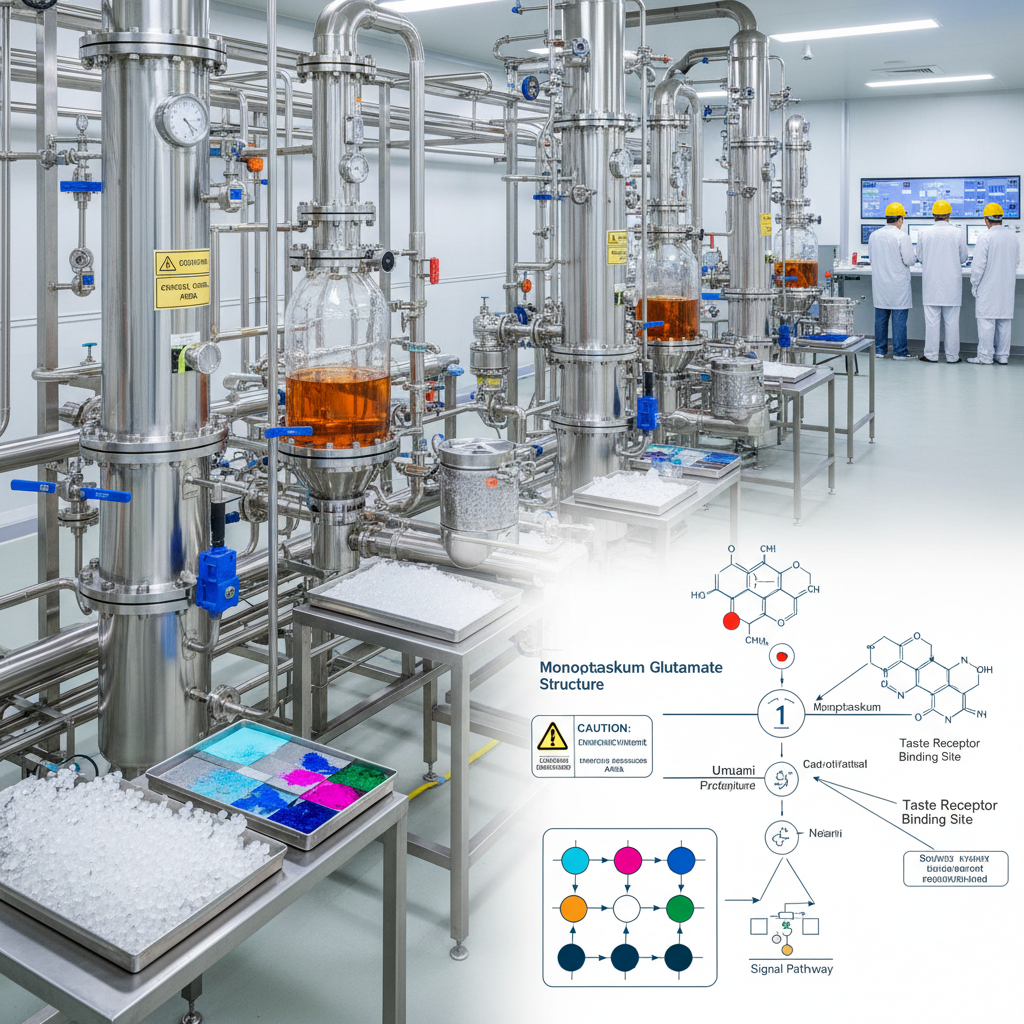
The production of high-quality monosodium glutamate begins with a rigorous crystallization and precipitation process. This operation is divided into critical stages: concentration, crystallization, and pot release. To ensure the crystals are uniform, transparent, and bright, the neutralizer used must possess a light transmittance of over 90% and minimal impurities. The process starts when the concentrated solution reaches 30-30.5 Be at 70°C, at which point crystal seeds are introduced to initiate growth.
A key technical challenge is the management of "pseudocrystals"—small new nuclei that appear as the solution concentrates. To prevent these from compromising the uniformity of the product, a "whole crystal" technique is employed, where warm water is added to dissolve these tiny nuclei without melting the primary crystal seeds. This meticulous balance of temperature and concentration ensures a consistent grain size, a hallmark of a premium food additive supplier.
Quality Standards and Purity Specifications
Precision in chemical specifications is the primary differentiator for a leading manufacturer. Monosodium Glutamate (MSG) must adhere to a strict molecular formula of C5 H8 NO4 Na H2O, with a guaranteed content of 99%. This level of purity ensures that the flavor enhancement is clean and devoid of off-notes, which is essential for large-scale food production where consistency across batches is non-negotiable.
Beyond primary content, secondary parameters such as transmittance (98%) and pH levels (6.7-7.5) are closely monitored. The control of contaminants is equally critical; chloride must be kept at 0.1%, sulfate at 0.05%, and iron at a mere 5ppm. Such stringent limits prevent chemical interference in food formulations and ensure that the final product remains safe for human consumption over long shelf lives.
Heavy metal limits are capped at 10ppm, adhering to international safety standards. By maintaining these rigorous specifications, a dedicated supplier provides the transparency and reliability that food chemists and quality assurance teams require to certify their own end-products for global markets.
The Strategic Importance of a Food Additive Supplier
Selecting a reliable food additive supplier is a strategic decision that impacts the entire production pipeline. The ability to source MSG that is not only pure but also physically consistent in particle size allows manufacturers to automate their blending processes without worrying about segregation or uneven distribution of the flavor enhancer.
A qualified food additive supplier does more than ship raw materials; they provide technical assurance. For instance, the use of diluted decoloring solutions during the crystallization process ensures a low supersaturated state, which promotes continuous crystal growth and minimizes the generation of new, unwanted nuclei.
Furthermore, the integration of mother liquor from centrifugation back into the next neutralization batch demonstrates an efficient, sustainable approach to manufacturing. This circularity in production reduces waste and optimizes yield, allowing a professional food additive supplier to offer competitive pricing without sacrificing the 99% purity standard.
Industrial Application and Dosage Efficiency
The practical application of MSG varies significantly depending on the food matrix. In normally salted foods, the optimal concentration for flavor enhancement typically ranges between 0.2% and 0.9%. This narrow window requires a high degree of precision in dosing, which is only possible when the additive is uniform in quality and particle distribution.
Beyond simple seasoning, MSG serves as a versatile tool for improving the palatability of bitter substances, particularly when combined with sugar in pharmaceutical preparations. This cross-industry utility underscores the need for a supplier who can provide different grades—from food-grade enhancers to high-purity laboratory reagents.
MSG Quality Performance by Supplier Method
Advanced Drying and Screening Technologies
The final physical state of MSG is determined by the drying process, which must remove moisture without degrading the crystal structure. Modern facilities employ a variety of methods, including box drying rooms, vacuum box drying, airflow drying, conveyor belt drying, and vibrating bed drying. Each method is chosen based on the required throughput and the specific moisture target.
To ensure the grain size is perfectly uniform, the dried crystals undergo vibration screening. This critical step removes oversized or undersized crystals, ensuring that the end-user receives a product with consistent flowability and dissolution rates. This attention to physical geometry is what separates a commodity trader from a specialized food additive supplier.
Pharmaceutical and Laboratory Utility of MSG
While primarily known as a food enhancer, the high-purity crystals produced by professional manufacturers are indispensable in the pharmaceutical sector. When used in conjunction with sugar, MSG is an effective agent for improving the palatability of bitter drugs, making medication more acceptable to patients, especially in pediatric applications.
In a laboratory setting, MSG serves as a critical reagent for biochemical research and food science analysis. The requirement for a 98% transmittance and strict heavy metal limits (10ppm) makes it suitable for analytical chemistry where interference from impurities could compromise experimental results.
The dual-purpose nature of the product means that a top-tier manufacturer must maintain separate quality control protocols for different grades. This versatility allows a single food additive supplier to support diverse industries, from commercial food processing to high-end clinical research.
Global Supply Chain and Manufacturer Selection
For procurement officers, the search for an ideal MSG manufacturer focuses on three pillars: quality guarantee, pricing stability, and origin transparency. China-origin factories often lead the market due to their integrated supply chains and mastery of the crystallization process, offering a wide selection of grades at competitive prices.
The ability to provide full specification sheets—detailing everything from the 99% content to the 0.05% sulfate limit—is a baseline requirement for any legitimate global partner. Transparency in the manufacturing process, including the method of centrifugation and the type of drying used, builds the trust necessary for long-term contracts.
Ultimately, the goal is to find a partner who can scale production while maintaining the strict pH range of 6.7-7.5 and the clarity of the crystals. By auditing the factory's screening and packaging protocols, buyers can ensure that the MSG delivered to their facility is ready for immediate use in their production lines.
Technical Specifications and Quality Benchmarks for MSG Production
| Parameter |
Standard Specification |
Industrial Impact |
Quality Grade |
| Purity Content |
99% |
Pure flavor delivery |
Premium |
| Transmittance |
98% |
Crystal clarity & brightness |
High-Grade |
| Heavy Metals |
< 10ppm |
Global safety compliance |
Pharmaceutical |
| Iron Content |
5ppm |
Prevention of discoloration |
Food Grade |
| pH Value |
6.7 - 7.5 |
Chemical stability |
Standard |
| Sulfate |
0.05% |
Minimal salt impurity |
Premium |
FAQS
For most normally salted food products, the recommended concentration for optimal flavor enhancement is between 0.2% and 0.9%. Exceeding this range may alter the intended taste profile, while falling below it may not provide the desired umami effect. A professional food additive supplier can provide guidance on precise dosing based on the specific food matrix being used.
Purity is verified through a combination of chemical analysis and physical testing. Standard benchmarks include a minimum content of 99%, a transmittance of 98%, and strict limits on impurities such as chloride (0.1%) and sulfate (0.05%). Additionally, heavy metals are capped at 10ppm to ensure safety and compliance with international food standards.
Whole crystal processing involves the strategic addition of warm water to a concentrating solution to dissolve "pseudocrystals" (small, unwanted nuclei) without melting the larger crystal seeds. This ensures that the final product has a uniform, transparent, and bright appearance, which is a key quality indicator for high-grade MSG.
Yes, high-purity MSG is often used in the pharmaceutical industry, particularly when combined with sugar to mask the bitter taste of certain medications. This improves the palatability of the drug, enhancing patient compliance, especially in pediatric medicine.
Depending on the production scale and quality requirements, several methods are effective: vacuum box drying for high purity, airflow or conveyor belt drying for high volume, and vibrating bed drying for efficiency. The critical final step is always vibration screening to ensure particle size uniformity.
Light transmittance (ideally above 98%) is a direct indicator of the purity and crystalline structure of the MSG. High transmittance means the product is free from cloudy impurities and internal defects, reflecting a high-quality crystallization process and a reliable food additive supplier.
Conclusion
The production of high-purity Monosodium Glutamate is a complex intersection of chemical engineering and quality control. From the precise management of crystallization seeds and "whole crystal" processing to the rigorous screening of final particles, every step is designed to ensure a 99% purity level and absolute consistency. By adhering to strict limits on heavy metals and sulfates, a professional manufacturer ensures that the final flavor enhancer is safe, effective, and versatile enough for use in food, pharmaceuticals, and laboratory research.
For businesses looking to optimize their product taste and quality, partnering with a transparent and technically proficient food additive supplier is essential. As the industry moves toward greater automation and stricter regulatory oversight, the value of factory-direct, quality-guaranteed ingredients cannot be overstated. We invite you to explore our comprehensive range of flavor enhancers and additive solutions to elevate your production standards. Visit our website: www.standard-seasoning.com