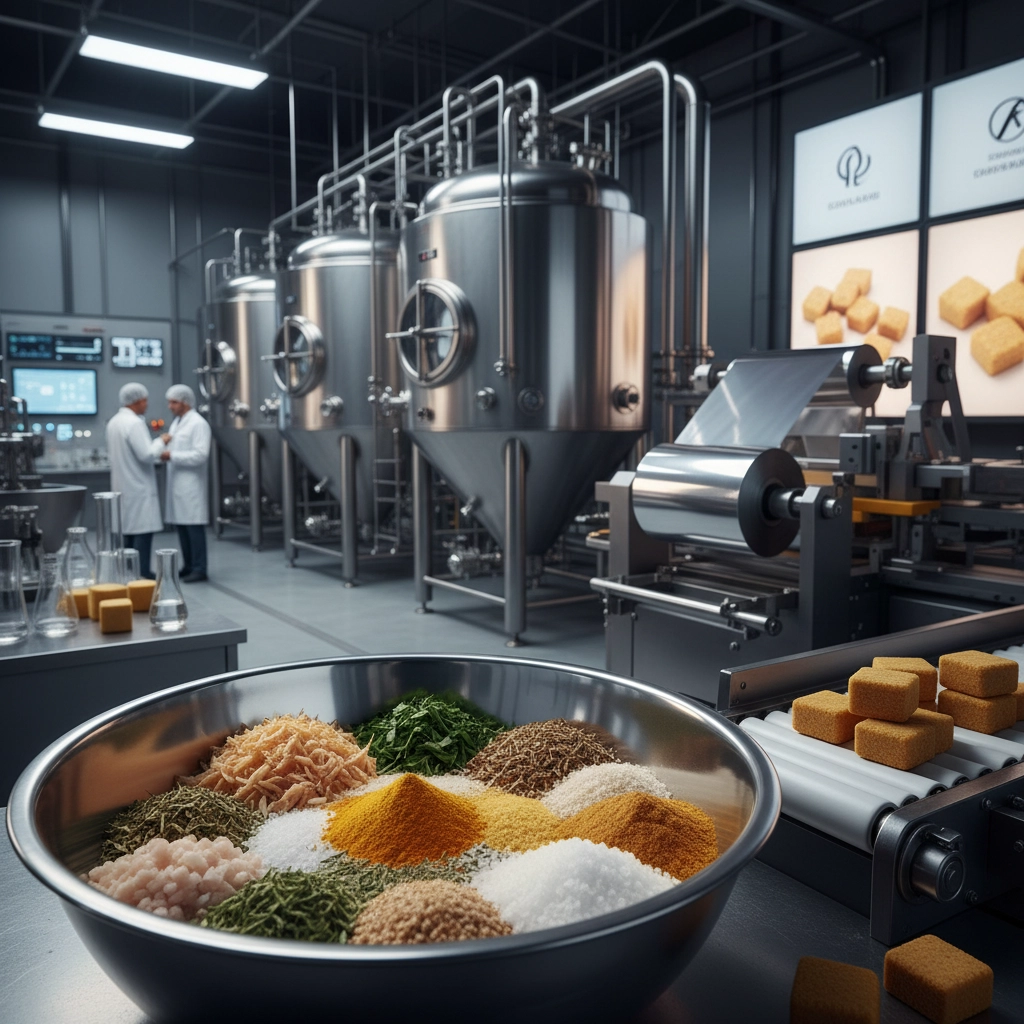
The global food processing industry relies heavily on high-quality flavor enhancers to maintain consistency and taste across large-scale production. Among these, the demand for efficient, bulk-supplied seasoning bases has grown as manufacturers seek to optimize their cost-to-flavor ratios while meeting strict regulatory standards.
Achieving the perfect savory profile requires a deep understanding of chemical crystallization and purity, ensuring that the final product remains stable during storage and transport. This is particularly critical for industrial-scale operations where a slight deviation in ingredient purity can alter the taste of thousands of consumer units.
Whether you are developing new recipes or sourcing raw materials for bulk chicken bouillon powder, understanding the underlying science of flavor enhancers like Monosodium Glutamate (MSG) is essential for achieving commercial success.
The Industrial Significance of Bulk Chicken Bouillon Powder
In the competitive landscape of food manufacturing, the ability to source bulk chicken bouillon powder that maintains a consistent umami profile is a strategic advantage. This product serves as a foundational building block for soups, sauces, and snacks, allowing brands to scale their production without compromising on the depth of flavor that consumers expect.
Beyond simple taste, the industrial application of these powders involves complex logistics and quality control. Ensuring that the powder remains free-flowing and resistant to clumping is vital for automated filling lines, which is why high-purity crystallization processes are employed during the manufacturing of the base enhancers.
Technical Process of Flavor Crystallization
The creation of high-grade flavor enhancers begins with a rigorous crystallization and precipitation process. This operation is divided into several critical stages: concentration, crystallization, and pot release. To ensure the final crystals are uniform, transparent, and bright, the neutralizer used must be exceptionally pure, typically requiring a light transmittance of over 90%.
During the initial crystallization phase, crystal seeds are introduced to a concentrated solution (approximately 30~30.5 Be at 70℃). As the growth rate of the grain is managed, "whole crystal" techniques are applied, where warm water is added to dissolve small, unwanted crystal nuclei (pseudocrystals) without melting the primary seeds, ensuring a consistent particle size.
To maintain a low supersaturated state and promote continuous growth, diluted decoloring solutions are added strategically. Once the grains reach the required size, the concentration is reduced to 29-39.5Be before discharging into centrifuge tanks, where the mother liquor is recovered for subsequent batches to maximize yield and efficiency.
Quality Parameters and Purity Standards
Maintaining strict chemical specifications is the only way to ensure that bulk chicken bouillon powder performs consistently across different food matrices. For instance, the core flavor enhancer, Monosodium Glutamate (MSG), must adhere to a purity level of 99% with a transmittance of 98% to avoid discoloration in the final product.
Key safety parameters include limiting heavy metals to 10ppm and iron to 5ppm, while ensuring chloride levels remain around 0.1% and sulfates at 0.05%. These tight tolerances prevent off-tastes and ensure the product meets international food safety standards for pharmaceutical and food-grade additives.
The pH value, typically ranging from 6.7 to 7.5, is critical for the stability of the bulk chicken bouillon powder formulation. A stable pH ensures that the powder interacts correctly with other ingredients, such as sugars or acids, without causing premature degradation or unwanted chemical reactions.
Cost Efficiency and Scalability in Production
For large-scale manufacturers, the cost-benefit analysis of sourcing bulk additives revolves around the balance of purity and price. By utilizing high-yield crystallization methods, producers can reduce waste and lower the per-unit cost of flavor enhancers, which directly impacts the bottom line of processed food lines.
Scalability is achieved through the implementation of advanced drying and screening technologies. By removing oversized or undersized crystals through vibration screening, manufacturers ensure that the powder integrates seamlessly into automated mixing systems, reducing downtime and waste.
Efficiency Ratings of Bulk Chicken Bouillon Powder Sourcing Methods
Global Applications of Savory Additives
Savory flavor enhancers are utilized across a diverse range of industries, from commercial food production to pharmaceutical applications. In the food sector, they are typically used in concentrations of 0.2-0.9% in salted foods to amplify the natural flavors of ingredients, making bulk chicken bouillon powder an indispensable tool for culinary engineers.
Beyond the kitchen, these high-purity crystals serve as laboratory reagents and are even used in the pharmaceutical industry. When combined with sugar, they are employed to improve the palatability of bitter drugs, demonstrating the versatility of the chemical crystallization process in enhancing human sensory experiences.
Innovations in Powder Stability and Drying
The final quality of a seasoning powder is heavily dependent on the drying method employed. Modern facilities have transitioned from simple box drying to more sophisticated systems such as vacuum box drying, airflow drying, and vibrating bed drying. These methods ensure that moisture content is minimized, preventing microbial growth and extending shelf life.
Innovation in conveyor belt drying has allowed for a more continuous production flow, reducing the risk of thermal degradation of the flavor molecules. By controlling the temperature and airflow precisely, manufacturers can produce crystals that are not only chemically pure but also physically stable for global shipping.
Further advancements in vibration screening allow for the removal of "fines" and oversized clumps. This ensures that bulk chicken bouillon powder maintains a uniform particle size, which is critical for consistent dissolution rates in industrial soup bases.
Comparative Analysis of Flavor Enhancer Grades
Understanding the difference between food-grade and pharmaceutical-grade enhancers is vital for procurement officers. While both may share a similar molecular formula (C5 H8 NO4 Na H2O), the tolerances for impurities like heavy metals and sulfates are significantly stricter in pharmaceutical applications.
The effectiveness of bulk chicken bouillon powder often depends on the synergistic effect of its components. High-purity MSG acting as the primary flavor enhancer works in tandem with other salts and extracts to create a full-bodied savory profile.
Ultimately, the choice of grade depends on the end-use case. For high-volume snack production, food-grade purity is sufficient, whereas laboratory reagents require the highest possible transmittance and lowest possible chloride levels to avoid interfering with chemical reactions.
Comparison of Monosodium Glutamate Specification Grades
| Grade Type |
Purity Level |
Heavy Metal Limit |
Primary Application |
| Standard Food Grade |
99% |
10ppm |
Bulk Seasoning |
| Premium Food Grade |
99.5% |
5ppm |
High-end Culinary |
| Pharmaceutical Grade |
99.9% |
2ppm |
Medicine Masking |
| Laboratory Reagent |
99.99% |
1ppm |
Chemical Analysis |
| Industrial Grade |
98% |
20ppm |
Feed Additives |
| Custom Blend Grade |
Variable |
10ppm |
Specialty Bouillon |
FAQS
For most commercially produced salted foods, flavor enhancers like those found in bulk chicken bouillon powder are used in concentrations between 0.2% and 0.9%. This range is sufficient to amplify the savory profile without overpowering the other natural ingredients in the recipe.
Crystallization ensures that the product is uniform, transparent, and bright. By controlling the "whole crystal" process and removing pseudocrystals, manufacturers can prevent clumping and ensure the powder dissolves quickly and evenly in industrial mixers.
Standard food-grade MSG typically requires a content purity of 99%, a light transmittance of 98%, and strict limits on impurities: Chloride (0.1%), Sulfate (0.05%), Iron (5ppm), and Heavy Metals (10ppm), with a pH range of 6.7 to 7.5.
While multiple methods exist, vibrating bed drying and airflow drying are highly efficient for large scales. They provide consistent heat distribution, ensuring the crystals are dried uniformly and screened effectively to remove oversized particles.
Yes, high-purity crystals are often used in the pharmaceutical industry. When mixed with sugar, they help improve the palatability of bitter drugs, making medication easier for patients to consume without altering the drug's efficacy.
Stability is achieved through precise drying and vibration screening. Ensuring low moisture content and uniform particle size prevents the powder from caking during transit, especially in humid environments common in international shipping.
Conclusion
The production of high-quality flavor enhancers for bulk chicken bouillon powder is a sophisticated intersection of chemical engineering and culinary science. From the precise control of crystallization and "whole crystal" growth to the implementation of advanced drying and screening technologies, every step is designed to ensure purity, stability, and consistent taste. By adhering to strict purity standards—such as 99% content and limited heavy metal traces—manufacturers can provide the food and pharmaceutical industries with a reliable tool for sensory enhancement.
Looking forward, the industry is moving toward even greater automation and sustainable crystallization processes to reduce waste and energy consumption. For businesses seeking to optimize their flavor profiles while maintaining cost-efficiency, partnering with a factory that prioritizes technical precision is the key to long-term success. We invite you to explore our professional solutions and high-purity additives by visiting our website: www.standard-seasoning.com.