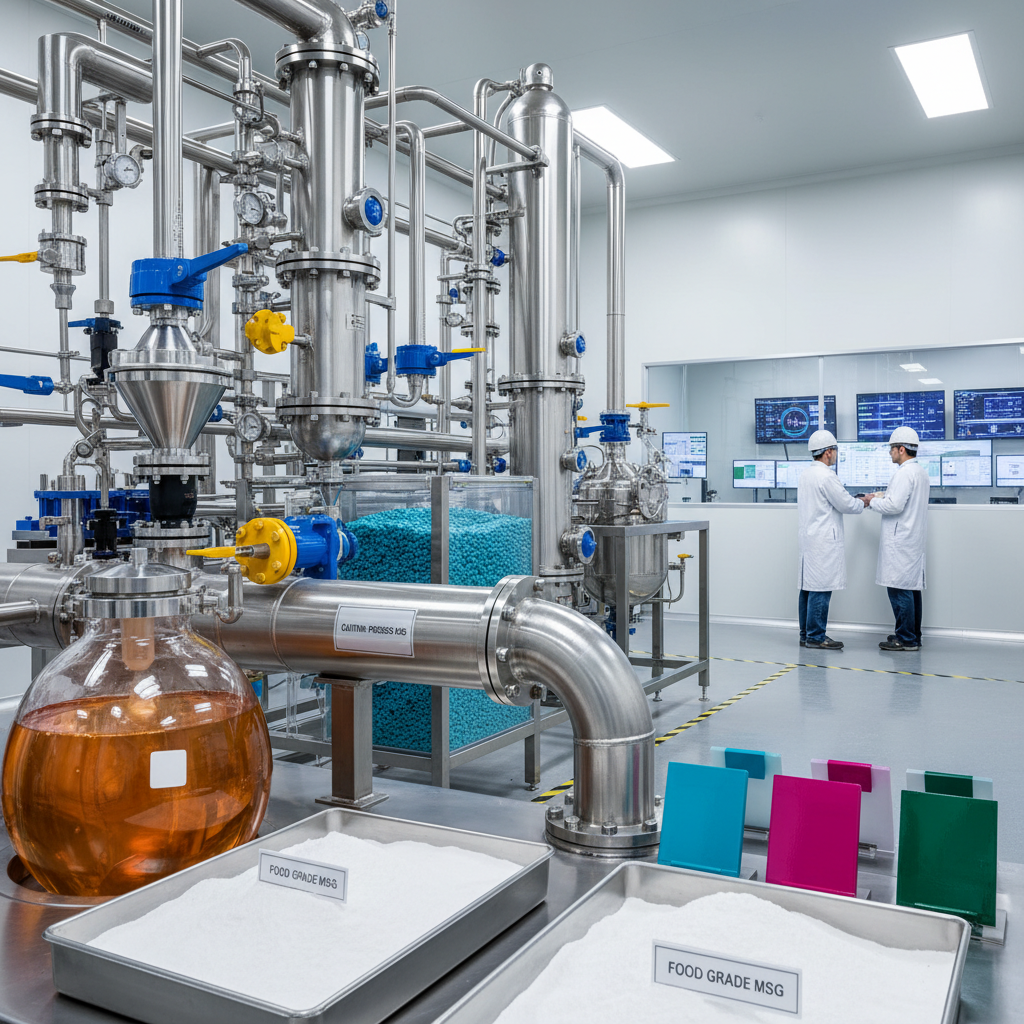
Monosodium Glutamate, commonly known as MSG, is one of the most widely utilized flavor enhancers in the global food industry. Understanding exactly what msg used for allows food manufacturers and culinary professionals to optimize the savory "umami" profile of their products, ensuring a satisfying taste experience for consumers worldwide.
From a technical perspective, the efficacy of this additive depends heavily on its purity and crystalline structure. The industrial process of crystallization and precipitation is critical to ensuring that the final product is uniform, transparent, and bright, which directly impacts its solubility and performance in various food matrices.
Whether it is serving as a primary food additive or a laboratory reagent, knowing the precise applications of msg used for helps in maintaining strict quality standards and regulatory compliance across the food and pharmaceutical sectors.
Industrial Production and Crystallization of MSG
The production of high-quality Monosodium Glutamate begins with a precise crystallization and precipitation process. This operation is divided into several critical stages: concentration, crystallization, and pot release. To ensure the final crystals are uniform, transparent, and bright, the neutralizer used must have minimal impurities and a light transmittance exceeding 90%.
During the crystallization phase, crystal seeds are introduced when the concentrated solution reaches 30-30.5 Be at 70°C. To prevent the uncontrolled growth of small "pseudocrystals" and ensure a uniform grain size, a process called "whole crystal" is employed, where warm water is added to dissolve new nuclei without melting the existing seeds.
Technical Specifications and Purity Standards
For MSG to be effective as a professional food additive, it must adhere to strict chemical specifications. The molecular formula C5 H8 NO4 Na H2O serves as the foundation, with a required content purity of 99%. This high level of purity ensures that the flavor enhancement is clean and consistent, without off-notes caused by impurities.
Other critical parameters include a transmittance of 98% and a pH range between 6.7 and 7.5. Control over inorganic impurities is equally vital, with limits set at 0.1% for chlorides, 0.05% for sulfates, and a maximum of 10ppm for heavy metals to ensure consumer safety and product stability.
Maintaining these specifications is essential for the product's performance. For instance, an iron content limited to 5ppm prevents unwanted discoloration in the final food product, ensuring that the additive remains invisible while providing maximum taste impact.
Primary Applications: What MSG is Used For
When exploring what msg used for in the food industry, the primary role is as a potent flavor enhancer. It is typically applied in concentrations of 0.2% to 0.9% in normally salted foods to amplify savory notes and create a more rounded taste profile.
Beyond simple seasoning, the versatility of msg used for various pharmaceutical applications is noteworthy. It is frequently combined with sugar to mask the bitterness of certain drugs, thereby improving the palatability of medicines for patients.
Additionally, the high purity of crystallized Monosodium Glutamate makes it an ideal laboratory reagent. In scientific settings, its stable chemical properties allow it to be used as a standard in biochemical research and food analysis.
Comparative Efficacy in Food Enhancement
The effectiveness of MSG compared to other flavor enhancers lies in its ability to target specific taste receptors on the tongue. By providing a concentrated source of glutamate, it triggers the umami sensation more efficiently than many natural alternatives, allowing manufacturers to reduce overall sodium intake while maintaining flavor.
In commercial food production, the balance between salt and glutamate is key. When used correctly, the additive synergizes with salt to create a deeper, more complex taste that is essential for snacks, soups, and processed meats.
Efficacy Comparison of msg used for Flavor Enhancement
Strategic Advantages in Commercial Food Manufacturing
The integration of high-purity MSG into food production offers significant cost-efficiency and scalability. Because it is effective at very low concentrations (0.2-0.9%), manufacturers can achieve a premium taste profile without needing large volumes of expensive raw ingredients.
Furthermore, the stability of the crystallized form ensures a long shelf life and ease of transport. This reliability makes it a cornerstone for global food supply chains, providing a consistent flavor standard across different geographic regions.
Quality Control in Drying and Packaging
Once centrifugation is complete, the separated crystals must undergo a rigorous drying process. Depending on the production scale, methods such as vacuum box drying, airflow drying, conveyor belt drying, or vibrating bed drying are utilized to remove residual moisture without degrading the crystal structure.
Consistency in particle size is paramount for industrial users. After drying, the crystals are screened via vibration to remove oversized or undersized grains. This ensures that the final product flows easily in automated dosing systems and dissolves uniformly in food mixtures.
The final packaging stage must protect the crystals from humidity, as MSG is hygroscopic. Proper sealing maintains the 99% content purity and ensures the product arrives at the manufacturer in optimal condition for application.
Analysis of MSG Application across Industries
The application of Monosodium Glutamate extends far beyond the kitchen. In the pharmaceutical industry, its role in improving the palatability of bitter drugs is essential for patient compliance, particularly in pediatric medicine.
In the realm of chemical research, the stringent purity requirements (98% transmittance, low heavy metals) make it an indispensable laboratory reagent. This dual nature—as both a mass-market food additive and a precision chemical—highlights its unique versatility.
Ultimately, the success of msg used for these diverse purposes depends on the manufacturer's ability to control the crystallization process, ensuring a product that is as chemically pure as it is functionally effective.
Industrial Application Matrix of Monosodium Glutamate
| Industry Sector |
Primary Function |
Required Purity |
Concentration/Grade |
| Processed Foods |
Umami Flavor Enhancer |
99% Content |
0.2% - 0.9% |
| Pharmaceuticals |
Bitter Taste Masking |
High Purity |
Pharma Grade |
| Laboratory |
Chemical Reagent |
98% Transmittance |
Reagent Grade |
| Condiments |
Salt Synergy |
99% Content |
Food Grade |
| Animal Feed |
Palatability Agent |
Standard Grade |
Feed Grade |
| Ready-to-Eat Meals |
Taste Standardization |
99% Content |
Industrial Grade |
FAQS
The primary purpose of msg used for in food is as a flavor enhancer that provides the "umami" or savory taste. By adding it in concentrations of 0.2-0.9% to normally salted foods, manufacturers can significantly increase the palatability and depth of flavor in products like soups, snacks, and sauces.
Yes, it has several non-food applications. In pharmaceuticals, it is used in combination with sugar to improve the palatability of bitter-tasting medications. Additionally, high-purity crystalline MSG is utilized as a laboratory reagent for biochemical research and analysis.
Crystallization determines the physical properties of the product. A precise process involving "whole crystal" techniques and high-transmittance neutralizers ensures that the crystals are uniform, transparent, and bright. This affects how easily the product dissolves and its overall purity (99%).
Industrial-grade MSG typically requires a content purity of 99%, a transmittance of 98%, and a pH level between 6.7 and 7.5. It also must maintain low levels of impurities, such as chloride (≤0.1%), sulfate (≤0.05%), and heavy metals (≤10ppm).
Drying removes moisture to prevent clumping and degradation. Screening via vibration is crucial to ensure a uniform particle size, which is essential for automated industrial dosing systems to function accurately and for the additive to dissolve consistently in food products.
When produced to the required purity standards (low heavy metals and high transmittance), it is safe and effective for masking bitter tastes in drugs. Always ensure the supplier provides a certificate of analysis (CoA) to confirm the specific grade is suitable for pharmaceutical application.
Conclusion
In summary, the utility of Monosodium Glutamate extends from being a critical flavor enhancer in global food production to a specialized tool in pharmaceutical and laboratory settings. Its effectiveness is fundamentally tied to the precision of its industrial production—specifically the crystallization, drying, and screening processes—which ensure 99% purity and optimal physical characteristics.
As the food industry moves toward more refined taste profiles and healthier sodium alternatives, the strategic use of high-purity MSG remains invaluable. By adhering to strict technical specifications, manufacturers can continue to deliver consistent, high-quality taste experiences across a diverse range of applications. For those seeking a reliable supplier of high-quality MSG, visit our website: www.standard-seasoning.com